$0.00
CheckoutHow not to spoil the skin with scrubs, application errors
 Facial scrubs are often taken lightly, considering them to
be the same pass-through as, for example, hand soap, which you can buy in the
supermarket, running past the cosmetic department, and then use "according
to your mood." Meanwhile, the scrub, thanks to the mode of action -
mechanical exfoliation, can be safely attributed to cosmetics, which can
seriously affect the condition of the skin, both in a good and in a bad sense.
This is aggravated by the fact that scrubs are often used spontaneously, having
noticed any violation of the smoothness of the skin - from peeling to rashes.
Needless to say, the effect can be obtained as a result exactly the opposite of
what was expected: together with the smoothness and freshness of the skin -
inflammation, dryness and increased sensitivity? We figure out how not to spoil
the skin with scrubs.
Facial scrubs are often taken lightly, considering them to
be the same pass-through as, for example, hand soap, which you can buy in the
supermarket, running past the cosmetic department, and then use "according
to your mood." Meanwhile, the scrub, thanks to the mode of action -
mechanical exfoliation, can be safely attributed to cosmetics, which can
seriously affect the condition of the skin, both in a good and in a bad sense.
This is aggravated by the fact that scrubs are often used spontaneously, having
noticed any violation of the smoothness of the skin - from peeling to rashes.
Needless to say, the effect can be obtained as a result exactly the opposite of
what was expected: together with the smoothness and freshness of the skin -
inflammation, dryness and increased sensitivity? We figure out how not to spoil
the skin with scrubs.
Contraindications to the use of a scrub
There are more than enough contraindications to the use of a scrub, so first, determine if you are part of one of the groups that are not even recommended to think about active mechanical exfoliation. What kind of skin should not use face scrubs?
- Sensitive. Everything is obvious here: sensitive skin will
react to "resurfacing" instantly - most likely, redness and
irritation. Don't tempt fate.
- Very dry or dehydrated. Dry and dehydrated skin is most
often indirectly also sensitive, often thin, fragile and a tendency to lose
moisture with any intense exposure. Only the softest scrubs specially designed
for this skin are suitable.
- With inflammation, acne. If you have breakouts,
inflammations, and worsening acne, you are bound to be overwhelmed by the temptation
to scrub it all off - and make a big mistake if you succumb to it. Scrubbing
during an exacerbation is a sure way to expand the focus of inflammation and
significantly worsen the situation. In no case!
- With rosacea. As with sensitive skin, a scrub, when used on skin with rosacea, can only make it worse, causing irritation, redness, and other unpleasant skin reactions.
The good news is that if you have normal, combination or oily skin that is not prone to inflammation and is not hypersensitive, then scrubs can be used. True, in this case it is worth following some simple rules, which we will talk about.
Three common mistakes when using face scrubs
- Too often. Even a mild, high-quality facial scrub can be
harmful if used too often. The optimal frequency of using the scrub is once a
week, and for those with dry or delicate skin - once every 2 weeks. Twice a
week, the scrub can only be used if the exfoliating particles in it are
replaced with something as gentle as possible, such as plant or cereal powder.
It is definitely not worth using a face scrub every day or every other day,
even if at first you seem to be happy with the result.
- Too intense. It is very important to apply the scrub
correctly and without serious effort. There may be variations in the
application depending on the specific product, but in a typical case, the scrub
is applied to damp skin, which you massage with the scrub very, very gently,
barely touching your face with your fingertips, and along the massage lines.
And, of course, avoiding the area of the eyelids and lips. There is no need
to delay the process: 2-3 minutes of a leisurely massage with a scrub is more
than enough. Do not rub hard, do not "sand" the skin, achieving the
sensation of scraping off the skin of the top layer. Act gently and carefully.
Rinse off the remains of the scrub with water at room temperature, spray the
skin with a natural hydrolate and do not forget to immediately apply your base
cream.
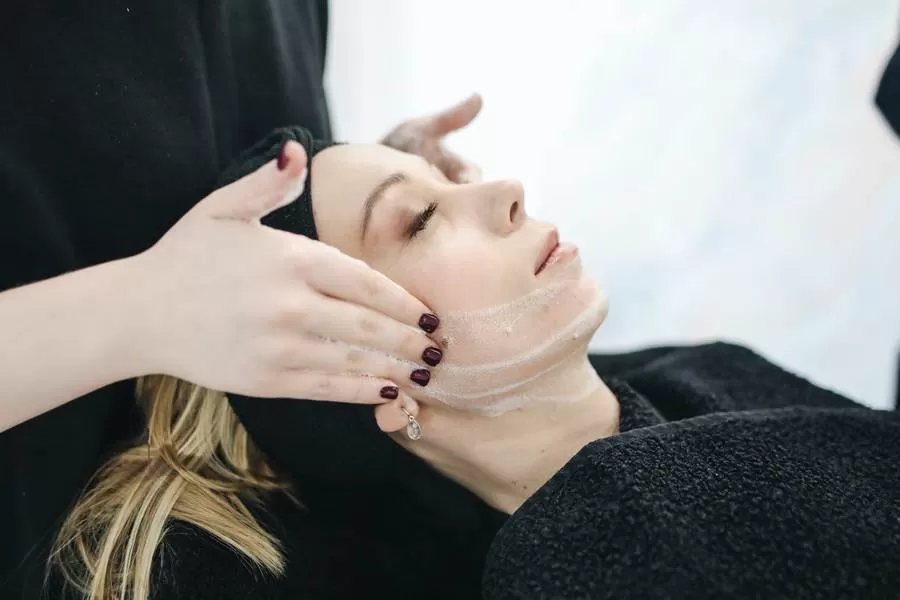
- Unsuccessful choice of means. First of all, avoid scrubs that are too dry with large and uneven particles (irregularly shaped, with sharp corners). When applying, you shouldn't have to tactilely feel every single exfoliating particle, it should feel more like the overall slight roughness of the entire product. In this case, you will feel roughness on the skin, as if your beloved house cat licks your hands. It shouldn't feel like rubbing your face with sandpaper or a hard cloth!
Important: when choosing, pay close attention to the
composition of the scrub and to the manufacturer's recommendations. A good
natural scrub will necessarily contain very small and properly rounded
particles, as well as components that soften the exfoliating effect, complement
it with care for renewed skin, for example, cosmetic oils and aloe vera, as
well as plant extracts and often essential oils that have a soothing, tonic and
a refreshing effect. Since manufacturers are trying to take into account the
needs of the widest possible audience, now you can find scrubs for dry,
sensitive, and problem skin. Sometimes these are scrubs-peels, various
gommages, scrubs-mousses and so on. Pay attention to manufacturer's
annotations, formulations and recommendations for use.
What about scrubs? If you have no contraindications, use
scrubs for health, but not too often and very carefully, choose high-quality
natural options with good compositions, and most importantly, monitor the
reaction of your skin. Do you see redness or irritation after using the scrub?
This means that it is not right for you! Do not expect a miracle - use it for
the body, and look for something suitable for the face.
Also, remember that scrubs did not converge like a wedge: there are many other options for thorough cleansing of the skin of the face.
Alternative: what to use instead of a scrub
Ubtan. The basis of ubtan is a powder (flour) of legumes and
cereals, which, when mixed with water, forms a slightly slippery gruel - and it
cleanses the skin just very carefully, working as a wash. Despite the fact that
ubtan acts mechanically, like a scrub, it does it very, very gently and
accumulates its effect on the skin: if you wash your face with ubtan regularly,
then you simply won't need additional exfoliation, because getting rid of dead
cells will happen anyway little by little all the time.
Cleansing masks. Clay, mineral or acidic - they work without
the slightest mechanical effect. For example, in the case of masks based on
clay or charcoal, deep cleansing occurs due to the absorbent properties of the
base components. Such masks not so much exfoliate, but penetrate into the pores
and very thoroughly cleanse the skin, plus a natural, subtle exfoliation occurs
during the application and rinsing process. Bottom line: the skin is clean
"to a squeak", softer and more delicate, but without the effect of
polishing.
Biocleaning. Zeolite, which is part of the mineral
biocleaner, is even more absorbent than clay, therefore it cleans the skin even
deeper, and its effect is enhanced by natural salts and minerals. Regular
application of the renewal, exfoliation occurs little by little, but often, so
the use of scrubs is not necessary at all if your basic care includes a
biocleaning (or a mineral scrub based on a biocleaning).
Peeling. At the same time, a very soft (zero mechanical
action) and a fairly deep way of getting rid of dead skin cells, occurs due to
active exfoliating components, for example, natural acids. In peels for home
use, the percentage of active ingredients is always small, so as not to
inadvertently harm the skin by excessively deep exfoliation, but still their
effect can be aggressive - if the product is not selected correctly or is used
incorrectly. Therefore, although when using peeling there is no factor of
mechanical friction and potential injury to the skin, you still need to carry
out the procedure carefully, monitoring the reaction of the skin, according to
the schedule recommended by the manufacturer.
Photos

03/02/2021 10:48:30
Comments:0
Views:820
Comments