$0.00
CheckoutTamanu oil and its application
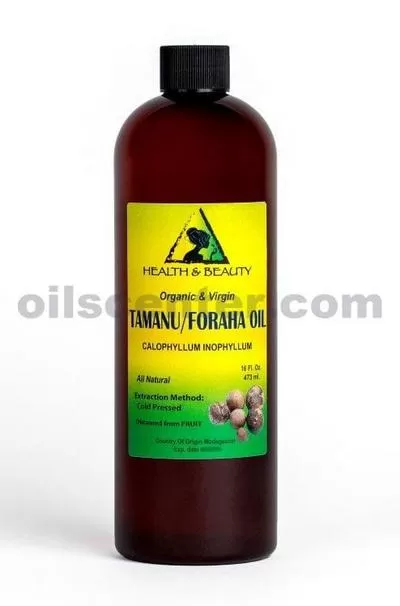
Sacred Alexandria Lavra and today is one of the most legendary representatives of woody, with unique healing properties. From Tamanu nuts, as this plant is also called in the West, valuable base oil is extracted. Thanks to its active composition, tamanu oil is absolutely dominated by strong healing and regenerative properties, which are virtually unparalleled due to the softness of its effect. This base is devoid of irritating and aggressive components, but at the same time affects the condition of the epidermis no less actively than those that have fairly bright properties that require balanced use. Oil from Alexandria Laurel is used exclusively in external methods, it is strictly forbidden to take it inside.
Production method

Base oil from Alexandria laurel is extracted from cores, thin-shell kernels, which contain more than 50% of the fatty oil released after two-stage drying for almost 4 months.
Initially, the crude base is mined by cold pressing. The resulting oil contains significant impurities of plant fractions and is very unstable in composition. Immediately after pressing it is filtered by mechanical methods, and then volatile and unstable substances are necessarily “bound” with an admixture of preservative in the form of natural vitamin E.
Other methods, including solvent extraction, do not allow to obtain an oil with a full and active composition.
Tamanu oil composition
Tamanu oil contains all three groups of lipids, which not only penetrate deeply into the skin, but also restore cell membranes and participate in their natural compounds. Moreover, it is the only one in which more than 90% of the composition is represented by neutral lipids. Phospholipids, triacylglycerols and glycolipids are the main "building" material for high-quality healing and renewal of skin cells.
Tamanu oil owes its unique healing talents to two components that stimulate the formation of healthy and full-fledged epidermal cells - these are calophyllolide and calophyllic acid. The first stimulates local immunity and is an active anti-inflammatory agent, the second is involved in the process of cell synthesis.
The oil got its special consistency due to a very high proportion of wax (about 7%).
As for the fatty acid composition, it is quite balanced, no acid dominates, and the main active components are oleic, palmitic, linoleic acids. The presence of small houses of unique behenic, erucic, myristic acids further enhances the healing properties of the oil.
The composition also contains terpenoids, steroids and active sterols.
Texture, color and aroma
Taman oil stands out with its rather thick, waxy consistency. Dense, viscous, it flaunts beautiful green tints of color, which sometimes seem to be amber-lime. At the first acquaintance, it seems unnecessarily heavy, aggressive and intense, but after the first application such an impression disappears.
A sediment may accumulate at the bottom of the oil container, which does not indicate poor base quality and is a natural phenomenon for this unstable oil. Shake well before use. At temperatures below room temperature, the tamanu thickens and even freezes.
The aroma of taman oil is quite specific, many even characterize it as unpleasant. It is quite pronounced, with flying upper notes of laurel aggressive smell, medium notes very similar to the spicy aroma of Indian curry and lower nut overtones. Caught as bright, rich, plant and exotic. The aroma of tamanu is not interrupted by essential oils and can only be slightly adjusted towards more recent, frankincense or walnut.
Skin behavior
When applied to the skin, tamanu oil in its pure form is perceived as very heavy, dense, but such sensations pass quite quickly. It is distributed evenly, but not very quickly, creating a film that seems greasy and a bit unpleasant. But you should not trust the first sensations: the oil from the Alexandrian laurel is absorbed very quickly and without residue, while not leaving even the slightest shine.
In areas of the skin with traces of irritation and damage, tamanu has an instant improving and external characteristics, and sensations effect, especially pronounced with allergic dermatitis.
Healing properties
Tamanu is one of the base oils whose healing properties are almost invisible. Even its effect on serious damage to the skin is more likely to be related to cosmetics.
Only the anti-inflammatory effect can be distinguished, which is perfectly manifested in the removal of rheumatic pain and inflammation of the joints, both traumatic and chronic.
It is strictly forbidden to take this oil inside; it is an external agent only.
Cosmetological properties
The effect of taman oil on the epidermis is determined by a complex of antibacterial and anti-inflammatory activity, which only enhances the most powerful healing effect among all bases.
Healing of damaged skin is the main area of use for Tamanu oil. It restores not only the structure of the skin at the cellular level, but also actively regenerates the blood and lymph circulation system, capillaries and skin texture. Quickly providing a calming effect on damaged tissues, tamanu relieves pain and reduces inflammation, accelerates the regeneration of all damaged layers and the formation of healthy cells.
Taman oil is used to heal abrasions, cuts, sutures, scars, bite marks, rashes, irritations, peeling, any other injuries and inflammations, from serious to light. In its scope can be attributed to chronic inflammation of the epidermis (acne, dermatitis, eczema), and cases of acute traumatic injury, burns and abscesses. This is a base oil for the care of postoperative scars and scars, which prevents complications and allows you to achieve maximum restoration of the natural aesthetics of the skin.
This oil has active protective abilities, prevents all negative effects of external factors. By quickly restoring blood circulation and activating cell metabolism, it helps to improve the structure of the skin.
Due to the unique content of components penetrating the membranes and the ability to influence the characteristics of cellular metabolism, tamanu is also considered one of the most active moisturizing oils. This is an excellent tool for protective, moisturizing care for sensitive and dry skin, a good regenerating agent for removing the effects of age-related changes and recovery after sunbathing.
Despite its very pronounced properties, tamanu is one of the most non-aggressive oils that can be used for rashes and dermatitis of various origins in children.
Due to its consistency and properties, tamanu oil is practically not used in hair care. Its characteristics are expressed primarily on the epidermis, almost not felt on the hair structure. The only exception is psoriasis and eczema of the scalp, in the treatment of which it is appropriate to use it.
Also, it is practically not used in the nail care system, except for cases of burr healing and other cuticle injuries.
Application features
This is a base with a universal scope, the only contraindication to the use of which is an internal technique.
Due to its thick and waxy consistency, tamanu oil is rarely used in its pure form, considering it both from the point of view of cosmetology and from the point of view of aromatherapy as an active additive. In a mixture with other bases, it is added in an amount of from 10 to 50%. Usually it is combined with jojoba and wheat germ oil.
Tamanu oil application methods and dosages:
- for aromatherapy purposes in its pure form as an active oil balm or as an additive from 10 to 50% to other base oils for oil applications, lotions;
- in hygiene products as an additive in an amount of 1-10% to another base;
- to improve cosmetics, both for general care and for therapeutic care in the amount of 5-20%;
- to create decorative cosmetics as an additive from 2 to 5%.
Photos
04/06/2020 09:17:48
Comments:0
Views:1167
Comments